Arrest & Control Private Lesson Example, Part One
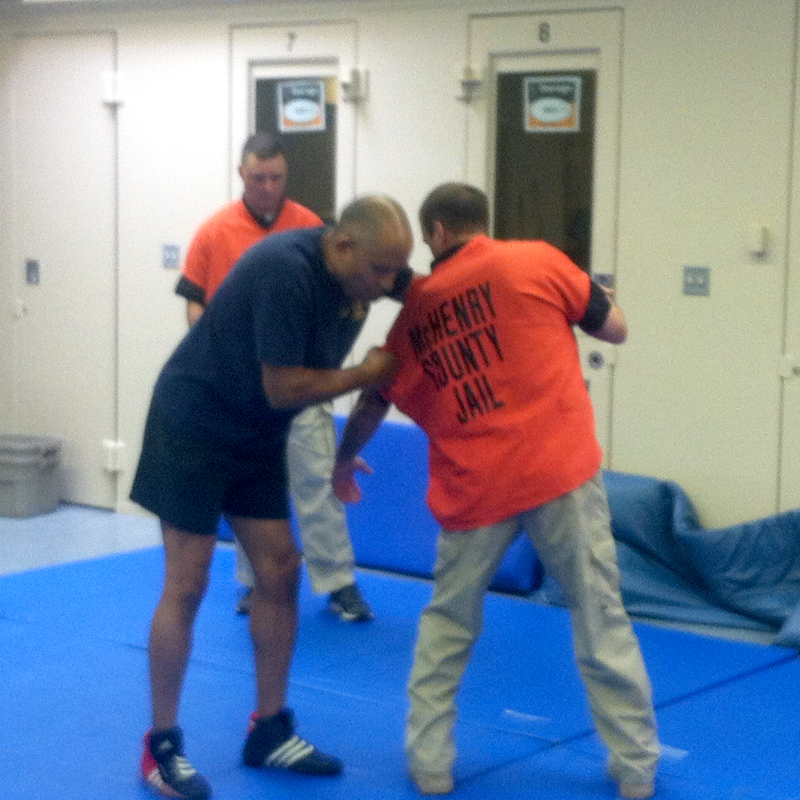
Below is an example of a few lessons I’ve taught to entry-level law enforcement personnel (e.g. officers, deputies, agents, etc.).
TECHNIQUE-BASED LESSONS: Effecting An Arrest
Level One Instruction (6 parts)
- Begin by teaching my 6-10 step process of effecting an arrest.
- Establish/secure your F.I. stance.
- Step forward and make contact with the subject/suspect.
- Establish/maintain control over the subject/suspect.
- Handcuff the subject/suspect.
- Safely transport the subject/suspect to a vehicle.
In the beginning, I will keep the instructions straightforward and streamlined. I do so because it helps with mental clarity and aids in memory. The downside of teaching like this is that some officers/deputies/agents begin to think that this is all I have to offer them. Little do they know I could spend 90 minutes just on the F.I. stance alone — because there’s that much information in this one area of training.
Story: Opening a Workshop
On a handful of occasions, I opened my workshops at police departments with the following words:
“Thank you very much for that warm introduction! My name is Roy Harris. I’d like to begin with a unique topic with which I’m sure you are unfamiliar…READING FEET!”
LONG PAUSE……
The pause was over 30 seconds — by design! Why? Because I wanted to have their undivided attention!
I continued… “There is so much information contained within the feet. Consider this: The face…is a natural liar. It can be difficult to correctly read the face — especially with all of its nuanced micro-expressions. The hands…well, they speak much more truth than the face. But they can also deceive. The feet…well, they can’t lie. They speak truth because they reveal intentions and purpose. You just need to be taught how to read them!”
“One last thing: Yes, I know some of you are thinking, ‘But it’s the hands that reach for a weapon, not the feet. And it’s the weapon that threatens my life, not the feet!’ To this, I reply, ‘You are correct. But then I would ask you to tell me the movements in his feet PRIOR TO reaching for the weapon.’ To this, I’m sure you’d become quiet because you’ve never taken the time to study such things — hence the reason why I am here!”
And with that, I began my workshop — with officers/deputies now curious as to what is going to come out of my mouth.
Level Two Instruction (12 parts)
- We will probe deeper into the multi-step process of making an arrest. And, we will begin with mindset training — the absolute MOST IMPORTANT area when it comes to practice and training!
- Next, we will investigate the Field Interview stance — because there’s a lot more to it than just putting your strong side back, bending your knees, and placing 50% of your weight on each foot. Also, I’ll teach them how to use distance and angle properly.
- Next, the focus of the practice will move from the F.I. stance to making a safe entry. This is the most vulnerable point in time during the contact.
- Next, the officers/deputies/agents will be taught how and where to make contact so they can either establish control of the person or establish a point of contact for “monitoring.”
- This is where we begin to focus on all the stuff that happens in between the initial physical contact and the handcuffing.
- This is where we focus on the other steps of the process, as well as putting everything together into several combinations.
A Sergeant’s Challenge
Once, while teaching a large group of officers, one of them asked me to put the control hold on him. He said, “I want to feel what it feels like when an expert puts it on!”
I walked over to where the officer was practicing. As soon as I touched him to demonstrate the control hold, the fight was on.
I secured my position as quickly as I could while looking around the training room to make eye contact with the ranking officer — because I needed to know if I had a green light to do what I was about to do. When I saw the ranking officer, he had his back to me. He was walking away from me with his face pointed toward the mats. He was also shaking his head. So, I took this as a “Green light!”
I took the officer to the ground from a standing position — while he was trying to push, punch, and get away. I planted him softly but firmly on his glutes. Once I got the officer to the ground, I lost control of his arm. I quickly re-established my control by using a position of leverage.
Next, I put the officer into a painful compliance hold and gave him loud and repeated verbal commands, “Look away from me! Cross your ankles! Pull your feet to your butt.” And when he complied, I released the pressure on his shoulder and helped him to stand up.
After our practice session, the “officer” came up to talk with me. Turns out, he was a sergeant. The issue, as he saw it, was one of presentation. Because I had presented my material in a “soft” and “technical” way, some of the officers present thought I had no idea what I was talking about. However, after the 12-second encounter with the 250+ lbs. resisting sergeant ended in a handcuffing position, there was now “a disturbance in the force.”
If you, as an officer, deputy, or agent, are interested in receiving additional training that can ensure you not only go home safely at EOS but also look and sound good on camera, let’s talk. Give me 2 hours of your time and I can make a positive impact on your career!
Also, if you are an administrator and would be interested in having me come in and work with your officers/deputies/agents on specific skill development, send an email to roy@royharris.com and let’s begin a dialogue!
Thank you for your time,
Roy Harris